Egg Homogenization: Enhancing Industrial Uses of Eggs in Manufacturing

You'll find that egg homogenization alters raw eggs into uniform, stable mixtures perfect for industrial use. This process breaks down yolks and whites into tiny, consistent particles while maintaining nutritional value. When you're manufacturing food products, homogenized eggs offer better quality control, improved emulsification, and enhanced product stability. From bakery goods to pharmaceuticals, these standardized ingredients streamline production processes. Investigate how advanced technologies are broadening the possibilities of egg processing across multiple industries.
Understanding Egg Homogenization Fundamentals
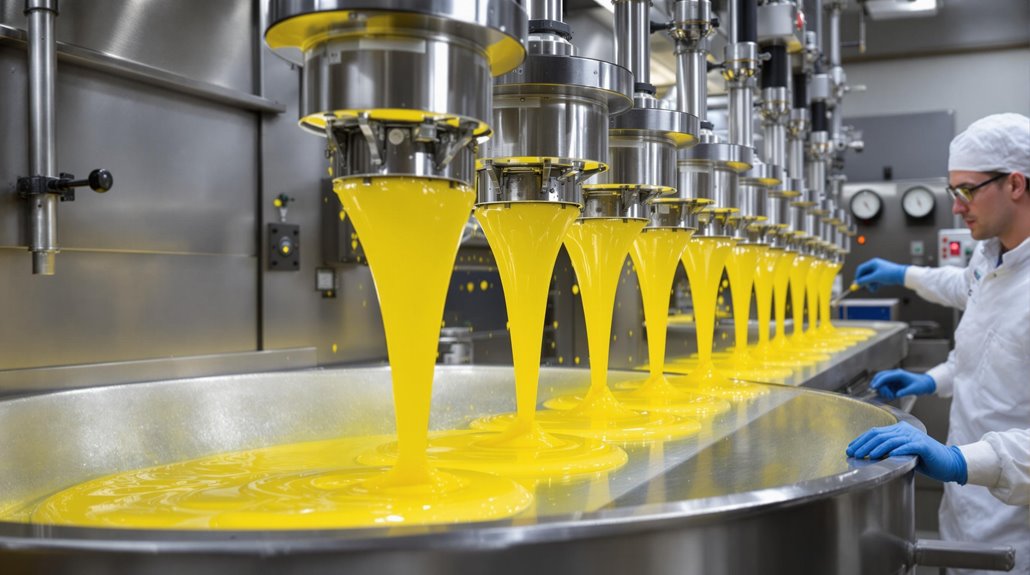
The process of egg homogenization stands as an indispensable industrial technique that alters raw eggs into uniform, stable mixtures. When you're working with liquid egg products, you'll find that homogenization breaks down both yolk and white components into tiny, consistent particles using high pressure between 60-120 bar.
During the process, you'll notice how protein denaturation occurs under controlled conditions, leading to improved emulsion stability in the final product. The system's temperature control mechanisms prevent overheating while maintaining optimal processing conditions.
You'll appreciate how this standardized approach guarantees that each batch meets quality specifications, making the homogenized eggs easier to handle and integrate into various food applications. This fundamental change of raw eggs creates a versatile ingredient that's pivotal for modern food manufacturing processes. The careful processing helps preserve essential amino acids that are critical for body function and repair.
Key Benefits of Homogenized Eggs in Manufacturing
Manufacturing efficiency soars with homogenized eggs, offering food producers multiple advantages in their production processes. When you're working with liquid whole egg in industrial applications, you'll find that homogenizers create a consistently smooth texture that's perfect for large-scale food production. The uniform distribution of ingredients guarantees better quality control and improved product consistency.
You'll notice that homogenized eggs are easier to handle and integrate into your food products, streamlining manufacturing operations. The enhanced emulsification properties result in more stable sauces and dressings, while the improved digestibility adds nutritional value to your finished products. By using homogenized eggs, you're not just simplifying your production process - you're also creating better-performing ingredients that can be used across a wider range of applications in food manufacturing.
The albumen proteins in eggs are particularly valuable for industrial food processing due to their excellent foaming and emulsifying properties.
Advanced Technologies in Egg Processing
Innovation drives modern egg processing technologies, altering traditional methods into sophisticated operations. You'll find Emerging Technologies like pulsed electric fields, ultrasonication, and high pressure systems being used to enhance eggs' functional properties and nutritional value.
Advanced homogenizers used in conjunction with heat treatment have revolutionized food safety standards while maintaining product quality.
The food industry now employs leading-edge solutions like ohmic heating and microfluidization to streamline pasteurization processes. You can see 3D printing creating custom egg products, while pulsed light and cold plasma treatments extend shelf life.
These technologies optimize the physicochemical properties of eggs, improving their performance in manufacturing applications. Understanding how these innovations affect egg characteristics is vital for developing superior products that meet modern industrial demands.
The protective calcium carbonate structure of eggshells provides a natural barrier that must be carefully considered when implementing new processing technologies.
Industrial Applications Across Sectors

While homogenized eggs serve numerous industries, their applications stretch far beyond traditional food manufacturing. You'll find industrial food processors using specialized homogenizers to create consistent, stable liquid products across various sectors.
Key applications include:
- Bakery manufacturing, where homogenized egg yolks improve the texture and shelf life of baked goods
- Cosmetic production, utilizing egg components in high-end skincare formulations
- Pharmaceutical development, where egg proteins serve as vital binding agents
- Biotechnology research, incorporating egg-derived substances in laboratory processes
The versatility of homogenized eggs continues to expand as new technologies emerge. You can see their impact in everything from mass-produced pastries to specialized medical products, making egg homogenization an indispensable process in modern manufacturing across multiple industries.
Emulsification Properties and Product Stability
The extraordinary power of egg homogenization lies in its ability to create uniform, stable emulsions by breaking down egg components into microscopic particles. When you're using industrial homogenizers and piston pumps, you'll achieve astonishing improvements in emulsification properties and product stability.
High pressure homogenization transforms liquid eggs by increasing their gelation temperature dramatically - from 65°C to 82°C for whole eggs and from 82°C to 95°C for yolks. This enhancement makes the products more versatile in filling machines and manufacturing processes.
You'll also notice a 14.8% increase in hydrolysis when combining high-pressure homogenization with heat treatment, improving both flowability and digestibility. The process restructures fatty acids while maintaining essential nutrients, shifting polyunsaturated fats from triglycerides to phospholipids. This means you're getting superior physicochemical properties without sacrificing nutritional value.
Quality Control Measures in Egg Homogenization
Maintaining rigorous quality control during egg homogenization requires a multi-faceted approach that combines precise temperature monitoring, particle size analysis, and exhaustive testing protocols. When you're working with egg liquid products, it's critical to control every aspect of the process to prevent phase separation and guarantee consistent quality.
Key quality control measures include:
- Temperature monitoring during pasteurization using calibrated sensors
- Regular testing of egg white functionality and emulsification properties
- Thorough cleaning and sanitization of homogenizers used in processing
- Continuous viscosity and particle size distribution analysis
You'll need to implement a comprehensive safety and quality system throughout the homogenization process. This includes maintaining proper documentation, conducting regular equipment inspections, and performing systematic quality checks to verify your homogenized egg products meet industry standards and customer specifications.
Equipment and Processing Parameters
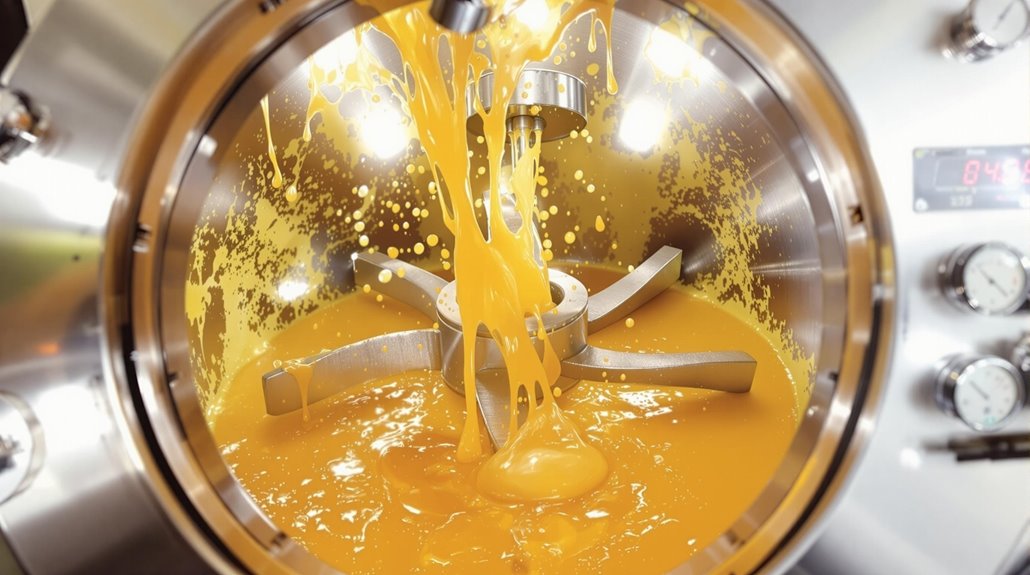
In modern egg processing facilities, advanced homogenization equipment operates under specific parameters to achieve ideal results. You'll find homogenizers used in egg processing working at pressures between 60 to 120 bar, which effectively break down proteins in egg components into uniform particles.
These machines incorporate multiple stages to guarantee thorough emulsification while maintaining precise heat treatments through built-in temperature controls. You can adjust processing speeds to match different product requirements, helping you optimize the consistency and shelf life of various egg-based formulations.
The equipment's sanitary design prioritizes easy cleaning and sterilization, which is pivotal for maintaining food safety standards. With these carefully controlled parameters, you're able to produce high-quality homogenized egg products that meet industry specifications while preserving consistent product quality throughout the manufacturing process.
Safety Standards and Regulatory Compliance
Because consumer safety is paramount in egg processing, strict adherence to regulatory standards established by the FDA and USDA forms the foundation of homogenization operations. You'll need to implement detailed food safety protocols that incorporate both pasteurization and homogenization requirements.
Key regulatory compliance measures include:
- Achieving a minimum 5-log reduction in pathogens through approved pasteurization methods
- Following strict HACCP plans and sanitation protocols during processing
- Maintaining thorough documentation of all processing parameters
- Conducting regular microbiological testing to verify product safety
You must guarantee your homogenized egg products meet specific standards for uniformity and emulsion stability while remaining free from contaminants. These requirements aren't just bureaucratic obstacles - they're essential safeguards that protect consumers and validate your product's safety for various food applications.
Ultrasonic Processing Innovations
Recent advances in ultrasonic processing technology have revolutionized egg homogenization methods. You'll find that ultrasonic pasteurization combines cavitation with heat and pressure to achieve superior bacterial reduction while preserving protein quality.
When you're processing liquid eggs, ultrasonic homogenization breaks down fat globules and creates stable emulsions with improved texture.
You can efficiently blend additives like xanthan gum using ultrasonic technology, which also optimizes spray-drying for egg powder production. Modern industrial processors, like those from Hielscher, offer high amplitudes for effective emulsification and include convenient CIP and SIP features.
When you combine high-pressure homogenization with heat treatment, you'll achieve enhanced flowability and thermal stability in liquid eggs and yolks. These innovations guarantee you maintain nutritional profiles while improving product quality and consistency.
Cost-Efficiency and Production Optimization

Modern egg homogenization systems offer three key cost-saving advantages: reduced energy consumption, minimized processing time, and optimized resource utilization. When you're processing egg products, choosing the right homogenizers used can vastly impact your cost-efficiency.
Ultrasonication systems reduce energy costs while maintaining effective pasteurization. High-pressure homogenizers enhance thermal stability, diminishing product waste. Combined pressure-heat-ultrasound treatments maximize bacterial reduction while preserving protein quality. Sequential processing methods improve flowability and digestibility, augmenting production yields.
To optimize your egg processing operations, you'll want to focus on manothermosonication techniques that achieve 5-log bacterial reduction while minimizing processing time. This approach guarantees production optimization by increasing gelation temperatures from 65°C to 82°C, leading to better product stability and reduced manufacturing costs.