Which Country Has the Most Maple Syrup Production?
Canada stands as the undisputed leader in global maple syrup production, generating over 75% of the world's supply. You'll find Quebec at the forefront of this sweet success, contributing 91% of Canada's total output through its well-organized syrup producers' federation. Vermont leads U.S. production as the world's second-largest producer, but Canada's dominance remains unchallenged. There's much more to explore about how this iconic industry shapes international markets and trade patterns.
Global Leaders in Maple Syrup Production
While several countries produce maple syrup, Canada dominates the global market with over 75% of the world's production. Quebec leads Canada's maple syrup industry, contributing a staggering 91% of the country's output. The Federation of Quebec Syrup Producers maintains strategic reserves to control market prices and guarantee stable supply.
In North America, you'll find the world's top maple syrup producers. Vermont stands as the second-largest producer globally, generating nearly 900,000 gallons annually. The United States maintains a strong presence in the industry, with New York also being a significant contributor. Ontario rounds out the major production regions, helping to cement North America's position as the world's primary maple syrup-producing region. Together, these areas supply most of the world's maple syrup needs. Canadian exports reached an impressive C$487 million value in 2016, with Quebec generating approximately 90% of these sales.
Quebec's Dominance in the Industry
Quebec's position in the maple syrup industry stands unmatched, producing an exceptional 91% of Canada's output and over 71% of the world's pure maple syrup. Through the Federation of Quebec Syrup Producers (FPAQ), established in 1958, the province maintains strategic reserves and manages marketing operations across rural warehouses.
The iron kettle innovation introduced by European settlers revolutionized syrup production methods in Quebec and across North America.
You'll find Quebec's maple syrup production creates significant economic impact through:
- Over 12,000 full-time jobs in the industry
- $186 million in annual tax revenue
- Maintaining Canada's 75% share of global production
As the world's leading producer, Quebec's dominance in the maple syrup industry isn't just about the numbers - it's about organization and control. The FPAQ's systematic approach to managing production and reserves has helped secure Canada's position as the global leader in maple syrup production.
The Rise of Vermont's Maple Syrup Market
Despite being dwarfed by Quebec's output, Vermont has emerged as the world's second-largest maple syrup producer, carving out a significant position in the global market. You'll find Vermont's maple producers averaging 3,451 taps per operation, converting maple sap into roughly 1,221 gallons of syrup annually through reverse osmosis and boiling processes. Their syrup quality benefits from sugar maple trees which contain optimal sap concentrations for premium production. While Quebec dominates North American production, Vermont's sugar maple operations have established themselves as vital suppliers to the U.S. market.
The state's large-scale producers rely heavily on maple syrup sales, which account for 90% of their revenue. They're now exploring growth opportunities in Asian and European exports, though they face challenges from climate uncertainties and market saturation concerns. Vermont's success in maple production continues to strengthen its position as America's premier maple syrup state.
Export Values and International Trade
As global demand for pure maple syrup continues to rise, Vermont's export values have expanded considerably, reaching $52 million in international sales during 2022. While Vermont leads U.S. production, Canada produces over 70% of the world's maple syrup and remains the largest producer of maple syrup globally.
Canada's Quebec region alone exports 40 million gallons of maple syrup annually to over 60 countries. The International Maple Syrup Producers Association reports growing markets in Asia, with South Korea becoming a major importer. The U.S. maintains its position as the world's second-largest producer, with Vermont contributing noticeably to export growth.
Canada's dominance as the world's top exporter and producer continues to shape international maple syrup trade patterns and market prices.
Production Methods and Quality Standards
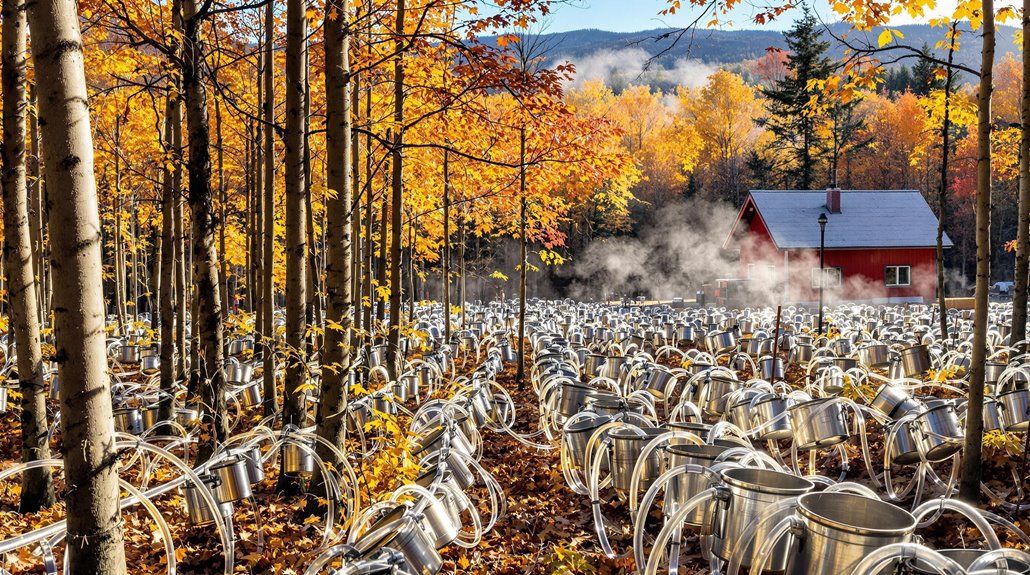
Modern maple syrup production follows strict quality standards while maintaining time-tested collection methods. You'll find that producers begin by drilling holes into maple trees during late winter when sap flow is ideal. While traditional bucket collection still exists, most operations now use plastic tubing systems to efficiently gather sap from hundreds or thousands of trees.
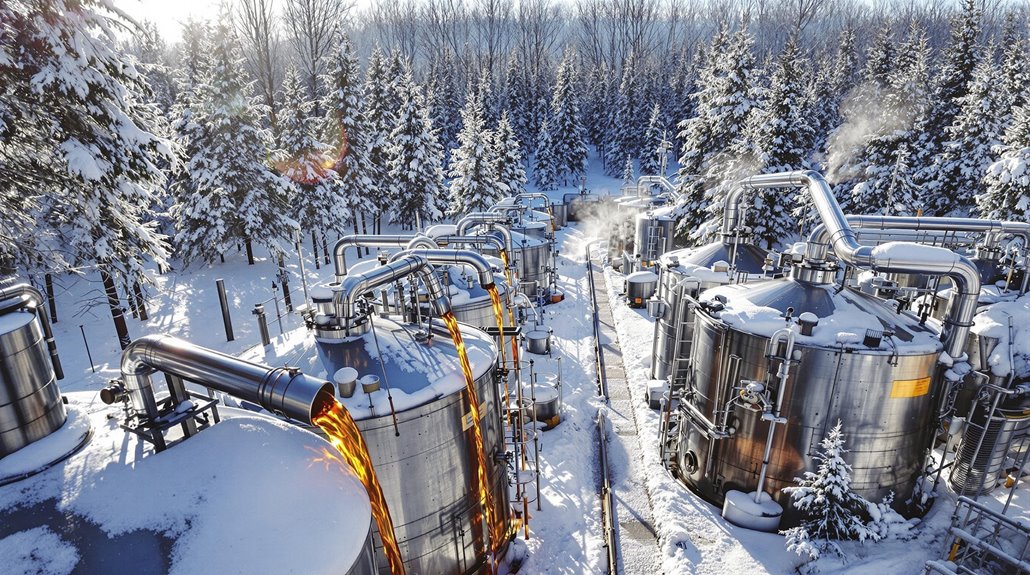
The collecting process has evolved with motor-powered tappers replacing manual tools, but the boiling process remains largely unchanged. You must carefully monitor the sugar content as the sap reduces, typically aiming for 66-67% sugar concentration. The syrup must achieve the desired consistency while meeting strict quality standards for color and taste. Producers regularly test samples to ascertain their syrup meets regional and international grading requirements before bottling.