What Are the 3 Types of Egg Production?
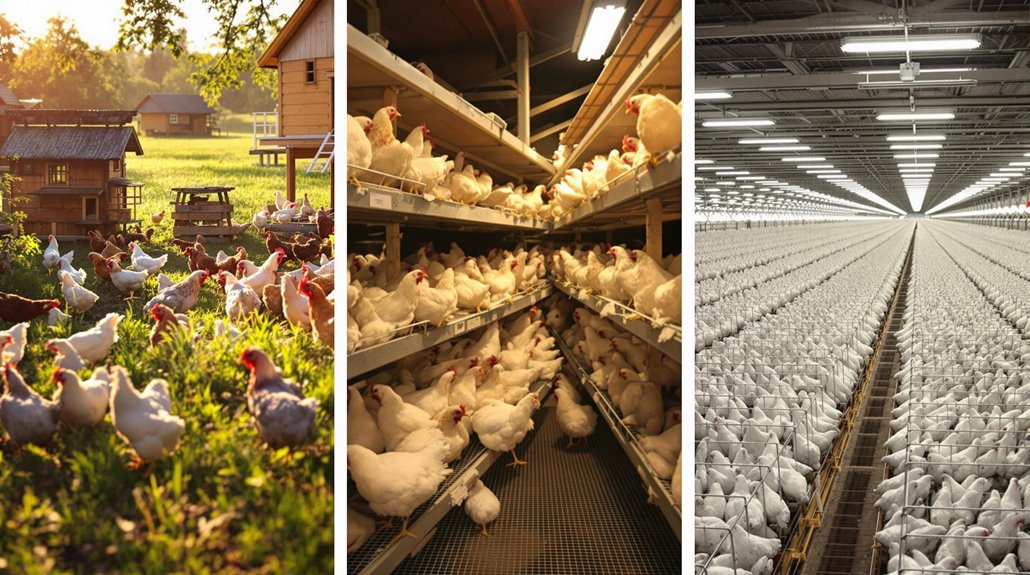
The three main types of egg production you'll encounter are conventional cage systems, cage-free housing, and organic/free-range operations. Conventional cages have dominated since the 1940s, prioritizing efficiency and controlled environments. Cage-free systems allow hens more natural movement inside buildings, while organic/free-range methods provide outdoor access and follow strict USDA regulations. Each system offers distinct advantages and challenges that shape modern egg farming practices.
Understanding Conventional Cage Egg Production
Since its introduction in the 1940s, conventional cage egg production has dominated the U.S. poultry industry, currently housing over 70% of laying hens. You'll find these indoor systems prioritize efficiency and control, providing hens with protected access to feed while maximizing productivity.
In the United States, conventional systems have proven highly effective at safeguarding hens from external threats like predators and harsh weather conditions. While each hen has designated floor space in an individual cage, this setup allows farmers to maintain strict environmental controls and monitor health conditions closely.
You'll notice these systems excel at disease prevention and enable precise management of feeding operations. The controlled environment of conventional egg production has made it the preferred choice for commercial farms, offering consistent results and maintaining high standards of bird health. Though less expensive than cage-free or organic options, conventional cage systems face increasing scrutiny over animal welfare concerns.
Exploring Cage-Free Housing Systems
While conventional cages remain the industry standard, cage-free housing systems have gained popularity as consumers seek more natural living conditions for laying hens. In these systems, chickens can roam freely within their enclosure, exhibiting natural behaviors like nesting, perching, and dust bathing.
You'll find two main types of cage-free operations: standard cage-free housing and certified organic under USDA regulations. The latter requires additional free-range access to outdoor areas. While these systems promote better animal welfare, they come with challenges. Cage-free and organic agriculture face increased risks of disease transmission, higher mortality rates, and reduced egg production efficiency.
The housing system also leads to more complex social hierarchies among chickens, which can result in aggressive pecking behavior. Despite these drawbacks, consumer demand continues to drive the industry toward cage-free alternatives. A healthy hen in a cage-free environment can produce 200-250 eggs annually, providing a significant return on investment for farmers.
The Rise of Organic and Free-Range Methods
Over the past decade, organic and free-range egg production has surged in response to growing consumer interest in animal welfare and sustainable farming practices. Research has found that while egg farmers are adapting to meet this demand, organic systems present unique challenges. Studies show that farm-to-table eggs contain higher levels of vitamins and healthy fats compared to conventional eggs.
Key aspects of organic and free-range production:
- Birds must have access to the outdoors, which can increase risks of predation
- Production costs are higher per dozen eggs per year compared to conventional layer housing
- Health and injury concerns are more challenging to manage than in conventional production and cage-free systems
- Natural pecking and social behaviors are more prevalent, which can affect flock welfare
- Only 6.8% of current egg production is organic, despite growing interest in brown and specialty eggs
These methods prioritize natural behaviors but require careful management to maintain productivity and bird health.