The Role of Egg Proteins in Pharmaceutical and Medical Applications

Egg proteins offer exceptional potential for your health and medical treatments. You'll find over 40 distinct proteins in eggs that provide antimicrobial, anti-inflammatory, and anti-cancer properties. The proteins can help manage blood pressure, support your immune system, and even serve as targeted drug delivery systems. From lysozyme's bacteria-fighting power to ovotransferrin's cancer-fighting abilities, these versatile compounds are revolutionizing modern pharmaceutical applications. Exploring their full therapeutic potential reveals an exciting frontier in medicine.
Understanding the Structure and Properties of Egg Proteins
While eggs may seem simple at first glance, they're remarkably complex protein powerhouses containing over 40 distinct proteins. You'll find these egg proteins are nutritionally complete, offering all essential amino acids your body needs, with excellent digestibility that makes them important for both food industry and pharmaceutical applications.
The presence of lysozyme, a small but powerful enzyme in egg whites, provides natural antimicrobial properties by breaking down bacterial cell walls. Additionally, you'll uncover unique proteins in egg yolks, like phosvitin and livetin, that show promise in bone metabolism and antimicrobial applications, expanding their potential in medical treatments.
What makes egg proteins particularly interesting for biomedical applications is their diverse functional properties. They can gel, emulsify, foam, and bind - characteristics that are essential in pharmaceutical development. The high-quality protein content of approximately 4 grams per egg white makes them especially valuable for medical nutrition therapy and protein supplementation.
Lysozyme: A Natural Antimicrobial Agent
Among the extraordinary proteins found in egg whites, lysozyme stands out as a potent natural antimicrobial agent. You'll find that this remarkable enzyme can break down bacterial cell walls, making it particularly effective against gram-positive bacteria. As a food preservative, lysozyme's natural antibacterial properties help extend shelf life and guarantee food safety.
You can enhance lysozyme's antimicrobial power by combining it with other compounds like chelators or nisin, which expands its effectiveness to include gram-negative bacteria. Beyond its antibacterial properties, lysozyme also demonstrates antifungal capabilities against various spoilage-causing fungi. These versatile characteristics have sparked significant interest in pharmaceutical and biomedical applications, where you'll see lysozyme being developed for antimicrobial coatings and drug delivery systems, revolutionizing how we approach medical treatments and food preservation.
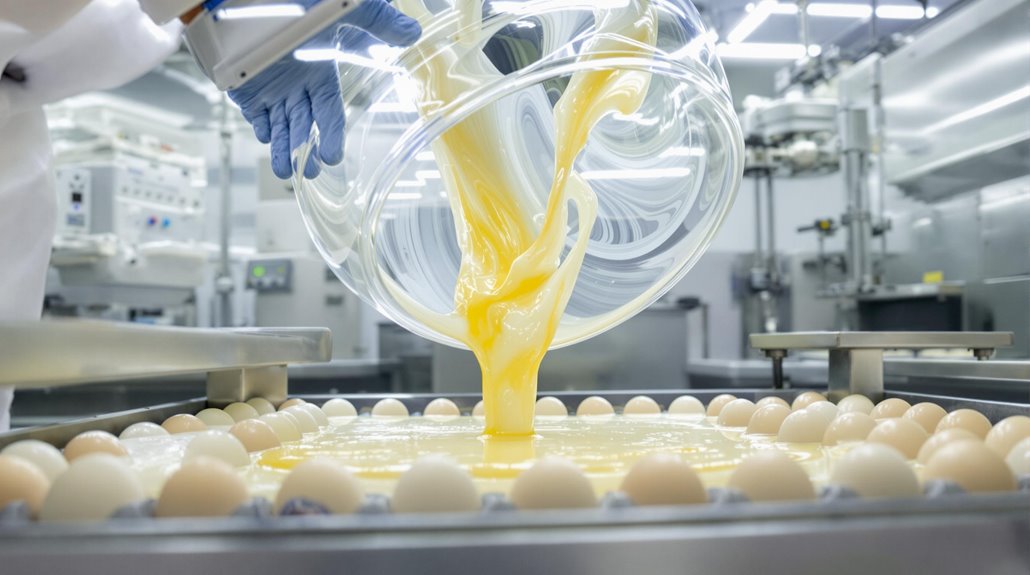
Modern robotic sorting systems ensure that eggs containing this valuable protein reach pharmaceutical manufacturers quickly, maintaining optimal quality for medical applications.
Therapeutic Applications in Cancer Treatment
Recent breakthroughs in cancer therapeutics have revealed the extraordinary potential of egg-derived proteins as anticancer agents. You'll find that hen egg white lysozyme exhibits remarkable anti-cancer activity, particularly against breast cancer cells when it's converted into nanostructured particles. While lysozyme exhibits its primary effects on Gram-negative bacteria, it's now showing promise in cancer treatment too.
Ovotransferrin hydrolysates target colon and breast cancer cells, while egg white peptides help prevent tumor growth by inhibiting cell migration. The egg yolk components aren't left behind - their livetins and enzymatic hydrolysis products demonstrate anti-inflammatory properties that support wound healing and cancer-fighting effects. These findings are transforming our understanding of how common egg proteins can be utilized for sophisticated therapeutic applications.
With Americans consuming 279 eggs per year, the abundant availability of these protein sources makes them particularly attractive for pharmaceutical development.
Anti-inflammatory Effects and Immune System Support

Studies examining egg-derived proteins have uncovered significant anti-inflammatory and immunomodulatory properties that make them precious therapeutic agents. You'll find that both egg white and yolk components offer exceptional benefits for immune system support and inflammation control. The combination of bioactive peptides, ovomucin, and lysozyme creates a powerful therapeutic arsenal.
Egg white hydrolysates can reduce inflammation by modulating gene expression in colitis cases. Ovomucin from egg yolk works by blocking pro-inflammatory cytokines. Egg yolk livetins and their hydrolysates demonstrate potent anti-inflammatory activities. Bioactive peptides from ovotransferrin help regulate immune system responses. Lysozyme provides dual benefits through its antimicrobial and anti-inflammatory properties.
These proteins and their derivatives won't just support your immune system - they're showing promise as natural alternatives to traditional anti-inflammatory medications.
Cardiovascular Benefits and Blood Pressure Management
Powerful cardiovascular benefits emerge from egg-derived proteins and peptides, particularly in managing blood pressure and promoting heart health. Research shows that specific egg white peptides like IQW and LKP act as ACE-inhibitory compounds, effectively reducing blood pressure in hypertension studies.
You'll find that ovotransferrin and its derivatives are especially promising for pharmaceutical applications in cardiovascular disease treatment.
The peptide IRW works by inhibiting angiotensin II-stimulated cell migration in blood vessels, while Promod 278P hydrolysate demonstrates significant ACE-inhibitory properties. Additionally, bioactive peptides extracted from egg yolk proteins offer antioxidant effects that support cardiovascular health. These findings highlight how egg-derived compounds could revolutionize blood pressure management and heart disease treatment through their natural therapeutic properties.
Drug Delivery Systems and Biomedical Engineering
Innovative drug delivery systems harness egg proteins' unique properties to revolutionize pharmaceutical applications. You'll find that proteins like ovalbumin and ovotransferrin excel in forming micro-particles and nano-particles, offering superior biocompatibility and biodegradability. These characteristics make them perfect for controlled drug release and tissue engineering applications.
Ovomucoid's mucoadhesive properties enhance drug delivery through various administration routes. Egg white proteins support regenerative medicine applications in wound healing. Natural bone graft materials benefit from egg-derived proteins' biological properties. Lecithin from egg yolk outperforms other lipid-based topical delivery systems. Eggshell membrane proteins provide cryoprotective effects for tissue preservation.
These versatile proteins are transforming biomedical engineering, offering solutions from drug delivery to tissue preservation. Their natural origin and favorable biological properties make them crucial in modern pharmaceutical applications.