
The History of Bacon: From Ancient Times to Modern Day
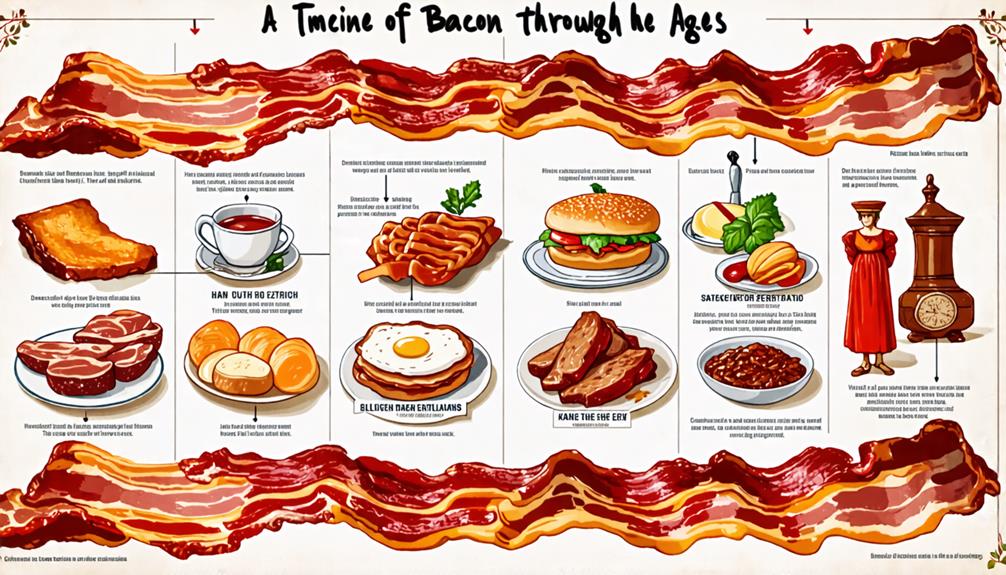
0When you think of bacon, you might picture a common breakfast food, but its history is ancient and varied. It started in ancient China around 1500 BCE, where people began salting and curing pork belly. This early method set the stage for the bacon we enjoy now.
As bacon traveled through Roman times and medieval Europe, each era added its own techniques and flavors. In colonial America, bacon became a staple in many kitchens, playing an important role in daily meals.
The history of bacon is as rich as its taste, offering a fascinating look into culinary traditions.
Bacon in Ancient China
Bacon's origins trace back to ancient China around 1500 BCE, where the practice of salting and curing pork belly began. This method was essential for preserving pork before refrigeration. The Chinese had domesticated pigs as early as 4900 BCE, leading to various techniques for preserving pork, including salting and curing.
By salting pork belly, they created a reliable protein source that could be stored for long periods, making it a staple in their diets. This wasn't just about preservation; curing also improved the flavor of the pork, making it a valued ingredient in many dishes.
Historical records show that cured pork belly was common in Chinese cuisine, providing both sustenance and flavor. These ancient methods eventually spread to other cultures, laying the groundwork for the bacon we enjoy today. The innovation of ancient China in salting and curing pork belly has had a lasting impact, shaping culinary practices around the world.
Roman Pork Curing
Around 300 B.C., the Romans developed advanced methods for curing pork, including salting and smoking. These techniques helped preserve their food supply, making pork last longer during travels and military campaigns. One of their early cured pork products, "petaso," was made from boiled pig shoulder, showing their innovative approach to meat preservation.
Roman pork curing practices transformed pork production across their empire. By salting and smoking pork, they not only extended its shelf life but also improved its flavor. These methods likely drew inspiration from the Middle East, where salting was already a common preservation technique.
Advancements in pig breeding and husbandry also increased the quality and quantity of pork. These efforts were essential in shaping the culinary traditions of ancient times. As these methods spread throughout the Roman Empire, they became a key part of European meat preservation and influenced culinary practices for centuries.
Medieval Bacon Practices
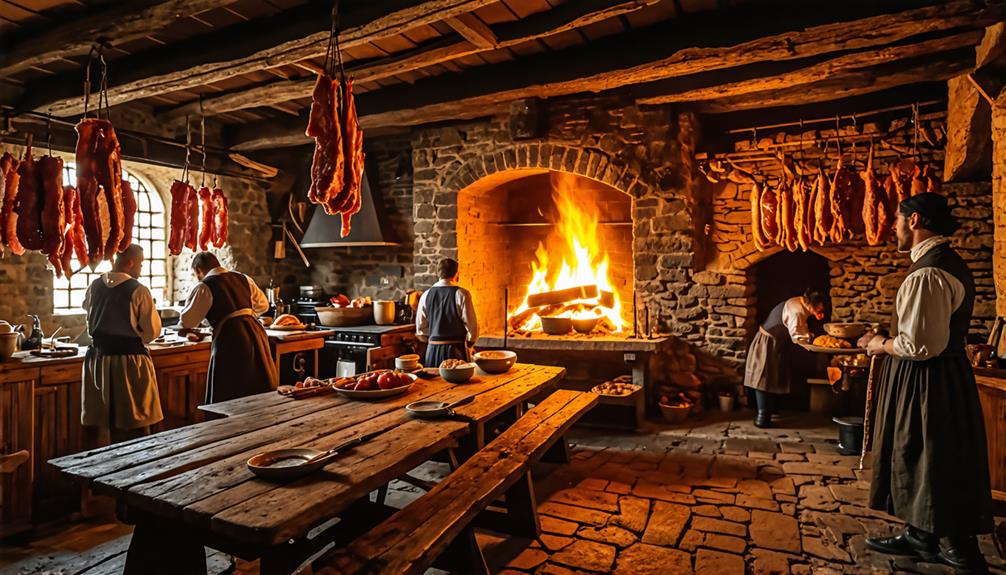
During Medieval Times, bacon was essential for Anglo-Saxon peasants. It added flavor and sustenance to their daily diets. Bacon and bacon fat were fundamental ingredients, enriching meals with vital taste and nutrition. The term "bacoun" in the 12th century referred to all pork, not just the salted and smoked belly we know today.
In medieval England, the church in Great Dunmow offered bacon as a reward to husbands who did not quarrel with their wives for a year. This tradition highlights bacon's cultural significance.
Key Aspects of Medieval Bacon Practices:
- Curing Techniques: Families and butchers developed methods to preserve pork. These techniques set the stage for modern bacon production.
- Pig Breeding: Specific breeds like Yorkshire and Tamworth pigs were raised for ideal bacon production.
- Terminology: "Bacoun" initially referred to all pork. The term narrowed in meaning during the 17th century.
- Cultural Practices: Bacon was so important that it was awarded as a prize for marital harmony in Great Dunmow.
Bacon's Journey to America
Bacon's journey to America started when Christopher Columbus brought eight pigs to Cuba in 1493. By 1539, Hernando de Soto had introduced 13 pigs to Tampa Bay, Florida. Within three years, these pigs had multiplied into a herd of 700. These events laid the foundation for the American pork industry and the widespread popularity of bacon across the continent.
Columbus' Cuban Pigs
In 1493, Queen Isabella sent Christopher Columbus to Cuba with eight pigs. This marked one of the first instances of pigs arriving in the New World. Columbus' introduction of pigs was crucial, setting the stage for future developments in American agriculture and the pork industry. These pigs in Cuba started a chain reaction that would shape the continent's history.
By 1539, Hernando de Soto arrived in Tampa Bay with 13 pigs. Within three years, these pigs multiplied into a herd of 700. This rapid growth was important for the American pork industry. De Soto's pigs also played a role in cultural exchanges with Indigenous peoples, who accepted pork as a peace offering.
Key points on the impact of pigs in early American history:
- Columbus in 1493: Introduced pigs to Cuba.
- De Soto's Herd: Grew to 700 pigs by 1542.
- Cultural Exchange: Pigs were peace offerings to Indigenous peoples.
- Agricultural Impact: Pigs became a staple in American agriculture.
These early introductions were essential for the development of the pork industry in America.
De Soto's Herd
Hernando de Soto's 1539 expedition to North America didn't just explore new territories; it also helped start the American pork industry. De Soto brought 13 pigs to the region, and in three years, his herd grew to about 700. This quick growth was a key moment in pork production and set the stage for the American pork industry.
Indigenous peoples accepted pigs and pork as peace offerings, showing how pork quickly became part of local diets. More pigs arrived from England in the 1600s, increasing the livestock population. By the 19th century, pigs roamed freely in places like New York City, highlighting pork's growing cultural and economic importance in America.
Here's a summary of how De Soto's introduction impacted the American pork industry:
| Year | Event | Impact |
|---|---|---|
| 1539 | Introduction of 13 pigs by De Soto | Foundation of American pork industry |
| 1542 | Herd grew to 700 pigs | Significant contribution to pork production |
| 1600s | Influx of pigs from England | Increased livestock population in urban areas |
De Soto's pigs were more than just animals; they became a key part of American culture and the economy.
Colonial Bacon Culture

In Colonial America, the arrival of pigs brought by explorers like Christopher Columbus and Hernando de Soto led to a booming pork industry. Bacon quickly became a household staple, offering an affordable source of protein. Without refrigeration, families had to cure and smoke pork at home. Each family often had its own recipe, making bacon a key part of their diet and cooking traditions.
By the 17th century, free-roaming pigs caused disruptions, such as in 1653 when pigs delayed the building of a wall on Manhattan Island. Despite these issues, bacon remained highly valued. The phrase "bringing home the bacon," originating in 12th-century England, emphasized bacon's cultural importance and was adopted into colonial life.
Here are four reasons why bacon was important during this period:
- Affordable Protein: Bacon was a cost-effective source of nourishment.
- Preservation: Curing and smoking allowed meat to be stored without refrigeration.
- Cultural Significance: Bacon symbolized sustenance and reward.
- Culinary Practices: Families created their own bacon recipes, enhancing their culinary traditions.
Bacon's role in colonial culture was multifaceted and significant in American history.
Industrialization of Bacon
To understand the industrialization of bacon, start by looking at John Harris's work. In the 1770s, he set up the first commercial bacon processing plant in Wiltshire, England. This was a pivotal moment for bacon production. The Wiltshire Cure method, known for its unique brine, created bacon with a distinctive flavor and less salt. By the 1920s, mass production techniques had evolved. Innovations like Oscar Mayer's sliced, packaged bacon made it easy for households to enjoy this popular meat.
Early Bacon Factories
John Harris established the first commercial bacon factory in Wiltshire, England, in the 1770s, marking the start of large-scale bacon production. Before this, people mainly made bacon at home in small batches. Harris's factory changed the industry by introducing commercial bacon production, which was key to the industrialization of bacon.
Harris's factory also developed the Wiltshire Cure method, a secret brine solution that made low-salt, sweet bacon. This method became popular worldwide. As the industry grew, new curing techniques using nitrates and nitrites were created. These methods allowed for mass production and extended the shelf life of bacon, making it more affordable.
By the 19th century, pig farming and bacon consumption grew significantly in the United States. This growth was supported by better transportation and refrigeration. The commercialization of bacon during this period included:
- Mass production techniques.
- Modern curing methods.
- Expansion of pig farming.
- Increased global consumption.
These changes helped bacon become a widely available and cherished food product.
Wiltshire Cure Method
The Wiltshire Cure method revolutionized bacon production by introducing a unique brine solution. This solution created low-salt, sweet-flavored bacon, which quickly became popular worldwide. John Harris developed this method in the 1770s, shifting from traditional home-based curing to large-scale commercial processing. The key to its success is the distinct flavor profile from a mix of salt, sugar, and spices used in the curing process.
The brine solution in the Wiltshire Cure method produces salt-cured pork that is less salty and more palatable. This sets it apart from other curing techniques. This innovation improves taste and ensures consistent quality in bacon production, meeting growing demand.
The first commercial bacon factory in Wiltshire marked a significant milestone. It enabled mass production and wider distribution of this unique bacon, laying the foundation for modern bacon production techniques. Today, the influence of the Wiltshire Cure method is evident in the flavor and quality of bacon available globally. This method transformed the curing process, making it a cornerstone of the bacon industry.
Large-Scale Production
The industrialization of bacon production began with John Harris in Wiltshire, England, in the 1770s. His commercial bacon processing plant marked the start of large-scale production, changing how bacon was cured.
The Industrial Revolution brought major advancements. Mechanized processes allowed for mass production, improving efficiency and scalability. By the early 20th century, refrigeration and transportation systems enabled the nationwide distribution of bacon in the United States. This made bacon more accessible to a wider audience.
Key milestones in the industrialization of bacon include:
- 1770s: John Harris establishes the first commercial bacon processing plant.
- Early 20th century: Refrigeration and transportation systems allow nationwide distribution.
- 1924: Oscar Mayer introduces pre-sliced and packaged bacon.
- Modern times: The use of nitrates and nitrites for preservation expands the variety of bacon products.
Modern production methods continue to evolve, ensuring bacon remains a convenient staple in households worldwide. These advancements allow you to enjoy a wide variety of bacon products, thanks to innovations that began centuries ago.
Bacon in Modern Cuisine

In recent decades, bacon has become a central part of modern cuisine, changing how we enjoy this popular meat. Bacon consumption in the U.S. has increased, with breakfast being a key time to eat it, often with eggs. The rise of bacon-focused restaurants has led to new culinary creations. You can now find bacon-wrapped foods, bacon-infused desserts, and gourmet bacon dishes that enhance various meals.
Bacon's versatility has also introduced unique bacon-flavored snacks and condiments. Products like bacon-flavored salt, Baconnaise, and bacon ice cream are now available. Gourmet bacon gift boxes and artisanal brands offer assorted options such as Buttery Prime Rib Bacon and Ranch Bacon, meeting the growing demand for quality products.
This rising demand has its challenges. Occasional shortages and price hikes show bacon's significant role in modern culinary trends. Despite these issues, interest in bacon continues to grow, securing its place as a key ingredient in contemporary cuisine.
Global Bacon Varieties
Bacon plays a key role in modern cuisine, and it's interesting to explore the many types enjoyed worldwide. Each variety offers unique flavors and textures to suit different tastes. American-style bacon, or streaky bacon, is made from pork belly. It is known for its high fat content and long, crispy strips. In contrast, Canadian bacon is sourced from the loin. It is leaner, resembling ham, and often served in thick slices.
Here are some global varieties:
- Pancetta: An Italian favorite made from pork belly. It is seasoned and dried, commonly used in pasta dishes and salads.
- Speck: A German specialty that is cured and smoked. It offers a distinct, robust flavor.
- Middle bacon: Popular in Australia and New Zealand, it combines both back and streaky cuts. This provides a balanced taste and texture.
- Turkey bacon: A low-fat, non-pork alternative. It caters to dietary restrictions, offering a healthier option without compromising on taste.
These global varieties show the versatility of bacon. Whether you prefer the rich taste of pork belly or the low-fat option of turkey bacon, there is a type of bacon for every palate.
Bacon's Cultural Impact

Bacon is more than just food; it's a cultural icon of indulgence and comfort. Over time, bacon has become a symbol of indulgence, celebrated through bacon-themed merchandise and festivals. The phrase "bring home the bacon," from a 12th-century English tradition, highlights bacon's historical importance and role in providing sustenance and rewards.
Today, social media amplifies bacon's status as a cultural phenomenon. You will find many memes, recipes, and bacon-related humor online, making it a staple in digital culture. This online presence has led to the rise of "bacontrepreneurs." These innovators have started bacon-centric businesses, offering products like bacon-flavored snacks and unique condiments.
In American cuisine, bacon holds a special place, with nearly $4 billion in sales as of 2013. Surveys show that 65% of Americans support bacon as a national food, underscoring its cultural significance. Bacon's journey from a simple food item to a beloved cultural symbol demonstrates its enduring appeal and widespread influence.
Related posts