How Is 100% Maple Syrup Made?
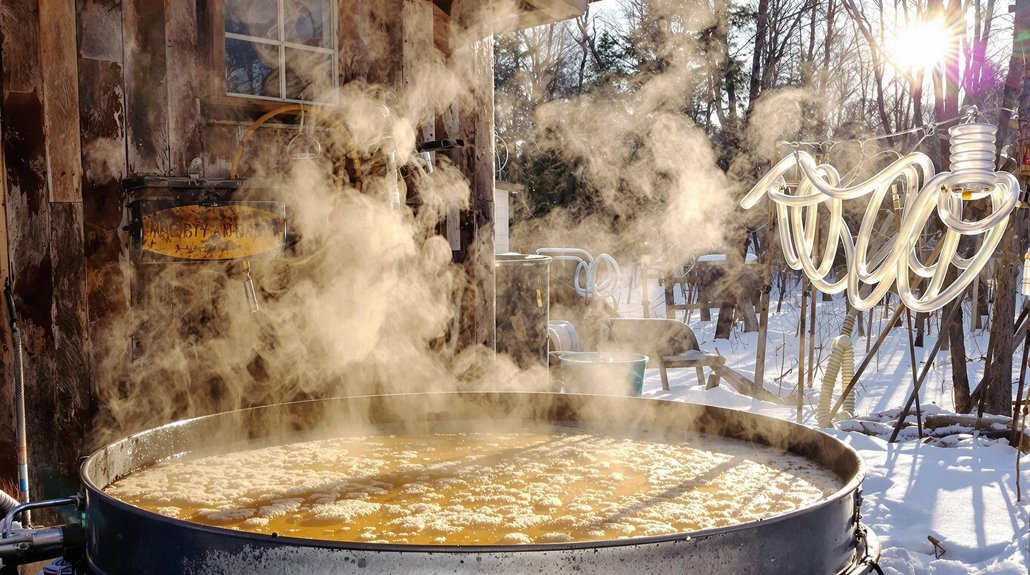
Pure maple syrup starts with mature maple trees, primarily sugar maples, that you tap by drilling small holes and inserting spiles. You'll collect the flowing sap, which contains just 2% sugar, and transport it quickly to a sugar house. There, you'll boil the sap in large evaporator pans until it reaches 66% sugar content - taking about 40 gallons of sap to make just 1 gallon of syrup. The fascinating conversion process holds even more sweet secrets.
The Art of Selecting and Tapping Maple Trees
When it comes to producing authentic maple syrup, selecting the appropriate trees is essential. You'll want to focus on sugar maple trees, as they produce sap with the highest sugar content, though red and black maple varieties are also suitable. Before you begin maple sugaring, guarantee your trees are mature enough - they should be at least 40 years old and 10-12 inches in diameter.
During sugaring season, you'll need to properly tap the trees by drilling small holes into the trunk. Once you've created a tap hole, insert a spile to collect the sap flow. You can use traditional buckets or modern tubing systems to gather the sap from sugar maple trees. Each tap will typically yield about 10 gallons of sap over the 4-6 week period when trees are tapped. Indigenous peoples first developed the technique of making diagonal slashes in maple trees to extract sap into birch bark containers.
From Sap to Sugar House: The Collection Process
Once the maple trees have been tapped, collecting and transporting the sap becomes a race against time. After you've tapped into the hole and inserted collection equipment, the maple sap begins flowing from sugar maple trees into either traditional buckets or modern tubing systems. You'll notice the clear sap contains only about 2% sugar content, which is why collecting large quantities is essential for maple syrup production.
The collected sap must be quickly transported to the sugar house, where the alteration begins. In the sugar house, you'll find the large evaporator pan where the boiling sap undergoes its extraordinary change. This is where the magic happens - as the water evaporates, the concentration increases until syrup produced reaches precisely 66% sugar content at 219°F, creating the pure maple syrup you love. Reverse osmosis technology has revolutionized modern production by concentrating the sap before boiling, significantly reducing processing time and energy use.
Transforming Raw Sap Through Evaporation
The conversion of maple sap into syrup begins with an intensive evaporation process in the sugar house. You'll find maple producers carefully monitoring large evaporator pans where they're boiling water from the sap to increase its sugar content. The process alters raw sap from 2% sugar to concentrated syrup at 66% sugar.
It's a precise operation that requires close attention to the temperature of the boiling sap, which must reach 219°F to be considered finished maple syrup. You'll need 40 gallons of sap to make one gallon of pure syrup.
Once the boiling is complete, producers filter the hot syrup to remove any sediment, ensuring a crystal-clear product. The final step involves packaging the syrup while it's still hot to preserve its authentic qualities. This traditional process, perfected by Indigenous peoples of Northeast, was later adapted and refined by European settlers to increase production efficiency.
Filtering and Grading Pure Maple Syrup
Pure maple syrup goes through rigorous filtering and grading steps to achieve its premium quality and classification. As sap flows from maple trees and converts into syrup through evaporation, you'll find that proper filtering removes all sediment and impurities, ensuring a clean, pure product.
The production of maple syrup yields different grades throughout the maple syrup season. Early in the season, you'll get Golden and Amber grades, which offer delicate, subtle flavors. As the season progresses, the syrup is graded Dark and Very Dark, providing more potent, intense profiles. Each grade must reach the proper density and sugar content to qualify as pure maple syrup. Unlike artificial alternatives, real maple syrup contains no additives and naturally features beneficial antioxidants and minerals, making it a superior choice for your table.
Proper Storage and Preservation Methods
Storing maple syrup properly guarantees you'll enjoy its sweet, distinct flavor for years to come. If you've got an unopened bottle, keep it in a cool dark place indefinitely.
Once opened, transfer your syrup to the refrigerator to extend its shelf life and prevent contamination. For long-term storage, you can freeze maple syrup while maintaining its flavor profile.
Consider these storage options to protect your syrup:
- Transfer syrup to clean mason jars, which let you easily monitor syrup levels
- Repack larger quantities into smaller containers to minimize air exposure
- Use freezer-safe containers if you're planning to freeze your syrup
- Store bottles upright to reduce contact with the container's lid
Remember to discard any syrup showing signs of mold, as it's no longer safe for consumption.